Monday, June 9, 2014

Why Are We Fascinated With Tiny Houses? Book Review: The Big TIny


Lately my husband and I have been fascinated with tiny houses. I'm not sure who started it, probably Irad. Perhaps it is an outgrowth of our weeks on the Appalachian Trail, discovering how completely we could meet our food and shelter needs from a backpack. Or our happy experiences doing Outward Bound which were equally unencumbered possession-wise. And yes I know this is a very First World Activity, to purposely scale down from the wealth and luxury of possessions around us as an OPTION.

But I can remember as a 10 year old doing a science project on being a naturalist, and imaging living in a tiny cabin in the woods with one little table and one bowl and the sound of the birds as my alarm clock. Of course I was 10 years old. Of course Irad has that fantasy as a 50 year old!

Somewhere I stumbled on a mention or review of The Big Tiny: A Built-It-Myself Memoir
and ordered it.

 The Tiny House of the title(picture by Stuart Islett for the NY Times)

The book is a delight. It reminds me of Cheryl Strayed Wild: From Lost to Found on the Pacific Crest Trail (Vintage).Though they are women at very different stages of life, they are both re-inventing themselves through a very physical quest that involves a lot of DIY learning and creates a lot of blisters and callouses. And they both write very humorously and humbly about their experiences. And both have a very West Coast ethos.

Loft bed looks comfy to me! (picture by Stuart Islett for the NY Times)

 For example, Dee Williams reminisces fondly about the shoes she keeps from the days when she and friends would "drive half the night and then sleep for a few hours at the trailhead, like kittens. We'd push ourselves through the day, sweating and grunting, and hanging by our knuckles as we attempted overly ambitious, nasty clims called something inane...I was strong and eager, and willing to drag myself (and my shoes) on any number of epic weekend adventures." Don't we all remember those days. (Not.) There are many references to outdoor get togethers, and gangs of friends cheering each other on, and having the modern day equivalent of a barn raising party at a key Little House building juncture—a kind of perpetual summer camp for the adult refugees of other parts of the country. So there is that.

The author with the friend whose yard she lives in (picture by Stuart Islett for the NY Times)

But what it leads to is this tremendous savoring of the details of the world. A living IN nature. Or as she herself says in an interview in the New York Times, “In a big house, it’s easier to ignore what’s going on outside,” she said. “Or you’re constantly trying to compete with nature through your thermostat. I’m more into collaborating with nature now.” Some of the loveliest writing in the book is when Williams describes experiencing the world around her through the heightened senses occasioned by living in such a modest and scaled down environment. I ordered the book imagining it would be interesting to page through, and to my surprise I read it cover to cover.

More perspective (picture by Stuart Islett for the NY Times)

The New York Times interview is worth reading and so is the book. Williams has a freshness and hopefulness about life, a kindness in her writing, and a deep appreciation of friends that is untarnished by her years as a toxic waste inspector. Nor is her sweetness tainted by her own terminal illness, whose advent lead her to re-evaluate the amount of time and debt home ownership imposed on her and start to explore a tiny house.

As for Irad and me, I don't know why we are both sending each other emails with links about other tiny homes, such as the recent Container Home Facebook Frenzy, since we have three kids and a dog and will not be fitting anywhere tiny anytime soon...but stay tuned. You never know!

Here are some of our recent shared links on the subject.
http://www.tumbleweedhouses.com/
http://www.huffingtonpost.com/news/tiny-homes/
http://www.fourlightshouses.com/  (the guy who inspired Dee Williams to build her own)
http://www.prefabcontainerhomes.org/
http://www.jetsongreen.com/2010/02/ten-things-consider-shipping-container-projects.html
http://www.buzzfeed.com/kristinchirico/surprisingly-gorgeous-homes-made-from-shipping-containers
http://www.realestate.com.au/blog/house-made-of-31-shipping-containers/ 

Movie Review: Edge of Tomorrow

picture from comingsoon.net

I am a sucker for a good sci-fi flick, and I heard from reliable sources that the new Tom Cruise movie was worth the trip. 13-year-old Fat Rabbit, an avid sci-fi fantasy reader and writer herself, came along.

Note. It is SO GREAT that my youngest child is now old enough to take to PG-13 movies!!! No more endless saccharine animations to sit through: I will take a pass on Toy Story14 and 15 and Despicable Next Generation and Mulan's Great Granddaughter and Monsters Inc Doing Post Docs. Yes, some of them were decent, but 21 years into motherhood I am ready to give them a miss.

This one was a combination of Groundhog Day, Pacific Rim and 12 Monkeys. The idea of the repeated day is not new to moviegoers, nor is mechanized war equipment, or revisiting the past to get it right. But nonetheless, it was a splendid ride and watching the evolution of the Tom Cruise character from smarmy PR salesman to passionate warrior chief was great fun. Emily Blunt does a great kick-ass female warrior, which I always enjoy, and the special effects were indeed special.

We saw the movie 3D. I have come to the conclusion that after the first 3 minutes of WOW we fatigue-out the 3D enhancement and experience the movie much as we would a 2D, so do not think it is worth the considerable price bump-up.

A satisfying summer flick, though probably ultimately forgettable. Unless we reset and see it again...


Friday, June 6, 2014

Terminal Tower: Observation Deck

picture from Don Iannone at flickr.com
Over Memorial Day Weekend we "vacationed" at home. This included a neighborhood barbeque, a movie ("Chef" - highly recommended), first outdoor swim of the season, and a trip downtown to the Terminal Tower.

Though I grew up in Cleveland I had never been up to the 42nd floor Observation Deck, which is open on week-end afternoons for the shocking price of $5 a peep. We took 13 year old Fat Rabbit, who also had never been up the tower, though both boys had gone during 4th grade class field trips.

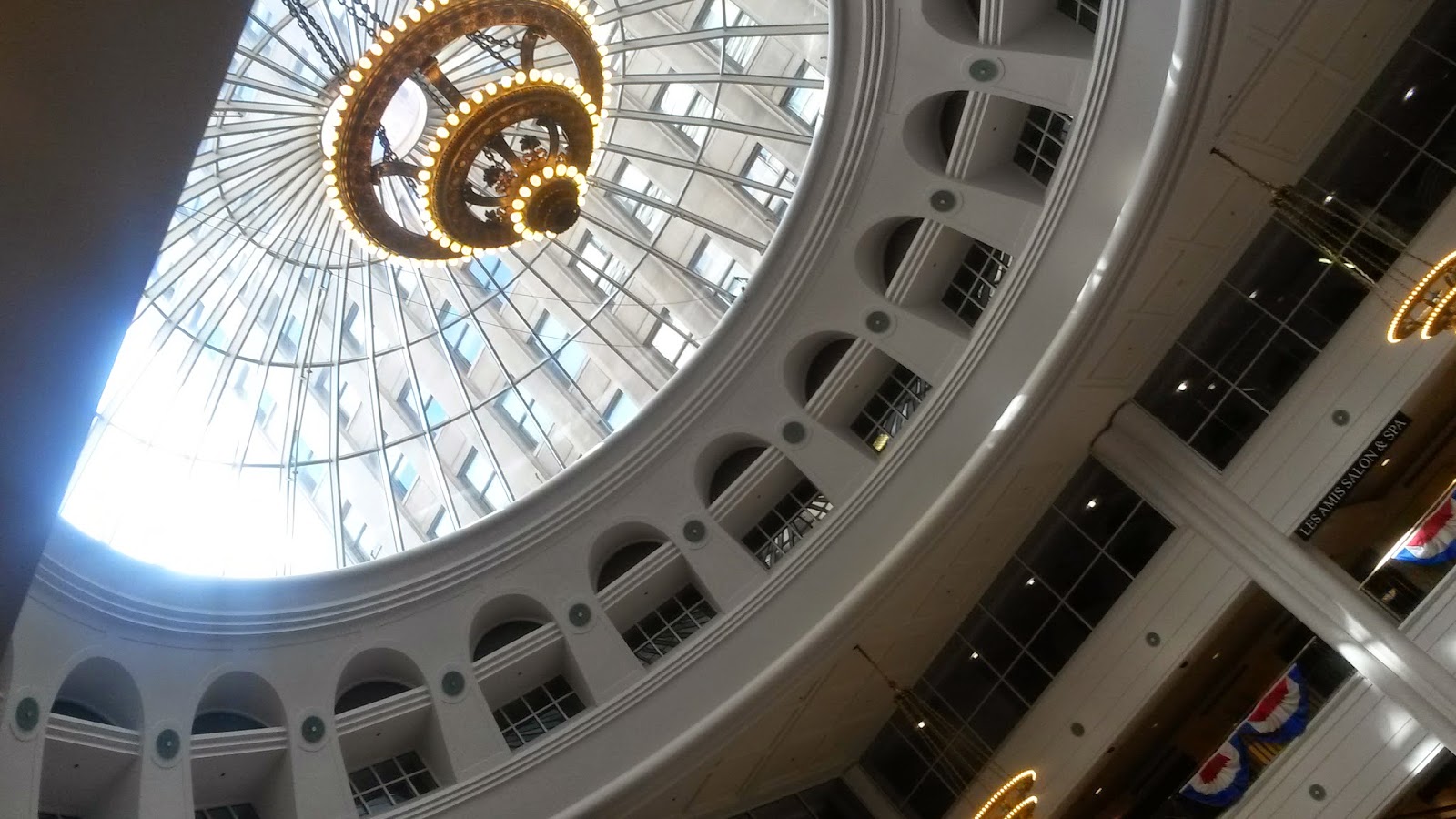
I have been through the Terminal Tower Mall on several occasions, usually rushing to a movie or an event, so I have never REALLY paid attention to the detail. It is a stunning building with a panoramic history of Cleveland. With our "vacation" heads on, we really noticed the beautiful foyer as we entered.
foyer as we saw it                           ceiling detail


[


After wandering around a bit and appreciating how beautiful the building is, magnificent, really, we bought our tickets and rode two elevators up to the 42nd floor. The observation deck had been restored to its original decor:

The compass came in handy for orientation, though the position of the lake is always a big tip-off in Cleveland! Um, north.  It was a clear day and visibility was extraordinary.

Cuyahoga river snaking back on itself


 My thought was that if this were the Empire State Building on a clear day, we would have waited in line for hours and vied with crowds for a view. But here in Cleveland, we went straight up and had the whole observation deck to ourselves. And the views were no less stunning.


Enhanced by Zemanta

Monday, April 28, 2014

Book Review: Snow Hunters


Paul Yoon's novel Snow Hunters: A Novelis a gem—perfectly cut and exquisite. Employing minimalistic writing it nonetheless conveys an entire rich and nuanced world. It lies somewhere between the realm of prose and poetry, each sentence is a distillation of language, and as such it is powerfully evocative.

The book has the feeling of a fable, images and events evoke universal experiences, yet it manages to tell a complete and coherent story. As I read I felt like I was immersed in an impressionistic piece, but in recounting the story to someone else, I realized that by the end of the narrative every detail had been filled in. Names, dates, events...it is a story of war, displacement, loss, and love and at times was so beautiful it brought tears to my eyes.

This is not a cheap read, but nor is it overly intellectual. Utterly approachable and every member of my book club seems to have loved and appreciated it equally - so much so that we are reading Paul Yoon's short story collection for next month.

It is great to live in a world where there are so many forms of genius to astound and delight!

Friday, April 18, 2014

Recent Reads: April

Note: You may need to disable ad blocker (temporarily)to see the pictures of the books.

After seeing it come up on every "Best Books of 2013" list in the world, I suggested Donna Tartt's The Goldfinch: (Pulitzer Prize for Fiction) to my book group. We all loved it, and we often don't agree on books.

The book has incredible range. Sprawling comes to mind. It gets a bit sloggy in the middle but I never thought about putting it down.

How does one author know so much? About art, about childhood, about high schools in Las Vegas? About PTSD, and addiction, and anxiety, crime and guilt? About the rich AND the poor, the intelligentsia and the underdogs and the rarified worlds of antique and art collectors? About Russians and oil and Europeans and art?

The book manages to be a Dickensian story of childhood, an Edith Wharton novel of the modern New York drawing room, a crime noir book and an action thriller all at once. And throughout it we have the single voice of Theo Decker to guide us. Though sometimes we even discover that Theo is an unreliable narrator, in moments when others correct his perceptions of the past with their own. Somehow the reader sticks with Theo, and comes to love some of the amazing characters who make their way into his life. I would give anything to meet Boris if he were real!

As with her earlier work, The Secret History the end of the book is in the opening, so we know Theo makes it to adulthood...but the narrative keeps us reaching to see how he gets there.
There is so much pain and anxiety in the book, but it is worth the pay-off at the end, a lush philosphical treatise that ties up all the ends, of the narrative, and of everything you have ever wondered about.  A really rich read! And apparently the Pulitzer committee agrees as the book is this year's fiction first prize winner.

 Because we had a lot of time and I was curious about Donna Tartt's work after reading so much about her I decided to read her other fairly famous book first, The Secret History in order to have more context about this Tartt phenomena.

Combination of Dostoevsky's  Crime and Punishment (Penguin Classics)
and campus novel, it is a very well done rumination on the nature of morality and the danger of attenuated intellectualism, the power of narcissists and psychopaths, the cult-like following and dangers of charismatic teachers, (something I've witnessed myself, but that is another story) and the effects of class in America. And not one likeable character to boot. But the novel holds together and exhibits the same writerly brilliance. Again, the depiction of addiction rings true, and I am reminded of how much drugs and drinking were on campus.


And now for something completely different! Light, charming yet not superficial, The Rosie Project: A Novel is the kind of book you can read in one night or on a plane and it will make you laugh, move you, and leave you rejoicing. A perfect read with pitch perfect writing. Another great book for the ever-growing cannon on Aspergers and Autism. IF I were creating a mini-class, I would pair this with the wonderful Autism novel The Curious Incident of the Dog in the Night-Timeby Mark Haddon.


By the way, I finally bailed on the Patricia Cromwell series with The Last Precinct (A Scarpetta Novel) which got too maudlin, morbid, depressive and obsessively psychoanalytic about a character who isn't even me, so why would I spent that kind of time in that level of analysis?

Just finished  Paul Yoon's Snow Hunters: A Novel but can't blog about it yet because it is on the dock for my next Book Club meeting and that wouldn't be fair...but highly recommended. More later.

Wednesday, April 16, 2014

Seder at My House


 Every home has their own traditions for seder. And each family has their own methods of preparing for this major psycho-drama re-enactment of the Exodus story; done through food, story-telling, song, and ritual. Here is something of how it goes at our house. Since many members of my family are vegan, we do a vegan-with-eggs seder, (since egg is one of the traditional foods).

The set-up MUST be done the day before, otherwise it is too crazy. We were seating 19 people this year, so the day before, Irad and I carried our kitchen table into the dining room as well as two kinds of folding chairs and spent two hours debating on the best way to set them up. I was for squishing everyone at one massive table configuration, and Irad voted for a separate "teen" table to the side. We went with his suggestion.

Passover has four names: chag hapesach, chag hamatzot, chag ha'aviv, and zman cheruteinu. (Holiday of Passover, of matza, of spring, and time of freedom.) I like to emphasize the "spring" holiday, especially after the harsh winter we experienced. So lots of flowers!


I spread the flowers out in tall narrow glasses so that there would a spring-like atmosphere to our spring holiday.


Next we had a long discussion as to the choice of haggadahs, the book used to guide the seder and tell the story. We have tried many different haggadot over the years, but in the end decided to go with the good ol' Maxwell House Haggadah, simply because it was the only one of which we had 19 copies!


We supplemented with a few pages from the Family Haggadah, a wonderful English-friendly version with lots of commentary appropriate for children and teens.


I will buy more of these for next year in the new edition.


We needed an English-friendly version because we had several non-Jewish friends in attendance, including friends from Korea, Vietnam, China, Ukraine and Lebanon.

In addition to the Haggadahs at the table, are the Haggadahs we take out and show:


The two on top are the ones we used, and the bottom row, from right to left (thinking in Hebrew) is a beautifully illustrated haggadah in the shape of the chamsa (hand), a children's haggadah from a kibbutz, a 1932 illustrated version of the famous Passover song Chag Gadya by Zeev Raban from the Bezalel School of Art, and finally, on the far left, a family Haggadah from Irad's family that was printed in 1893 in Vilna and made its way to Palestine in 1904.

The other artifact of great pride in each family is the seder plate. We have three and coincidentally had three tables set, so each table had its own plate. One inherited from my grandmother, one that was a gift from Irad's parents, and one that was a farewell gift to me from a congregation I served in New Jersey.


 This is a seder plate we don't own, but isn't it gorgeous?

Seder Plate from museum near the Great Synagogue in Budapest

Before it all begins the guest trickle in and of course they hang out in the kitchen!


Here is the seder checklist:
Seder plate set with—
Shank bone (paper depiction for our vegan household) to recall the lamb's blood on the doorposts
parsley - for spring and rebirth
maror - lettuce - bitterness of slavery
chazeret - home-made horseradish that Irad always makes with the kids wearing goggles) - tears for the bitterness of slavery
charoset - a "mortar" like mixture of apples, nuts, honey, sweet wine, and in our house, dates.
hard-boiled egg - life and renewal

Three ceremonial matzas on a plate or special matza envelope. The middle one is broken in half, and the leader hides one half for children to find later.

Elijahs' cup - Elijah comes to every seder and drinks from the cup. He will only come back "full-time" in the Messianic Age, when we have fixed all the crappy problems on Earth.

Salt water distributed around the table for the dipping of the celery, and later for the egg.

The best part of the pre-meal ceremony is eating the Hillel sandwich - a combination of the "mortar" for the bricks and the chazeret, or horseradish, on matza.


And now, the menu:
APPETIZERS
Hard-boiled eggs with salt water

Mock chopped liver (made by my mother)

Persian vegetable soup with matza balls (made by Yuval)

MAIN COURSES

Full plate of main courses

 Quinoa tabouli (quinoa is kosher for pesach, as it is not actually a grain, but a botanical member of the "goosefoot" family. which also includes beets and spinach.)


Flat lima beans slow cooked all day with beet greens. (We eat beans, though most Ashkenazi Jews don't)

Beet salad with cumin and onions (recipe I learned when we lived in Jerusalem)

Beet salad with apples and walnuts (recipe from my mother-in-law)

Nut Loaf (made by Yuval)

Sweet potato kugel (made by Irad)

Roasted butternut squash and kale (made by Julie)


DESSERT

Plum and Apricot Compote

Apple Pear Crumble (made with matza meal)


Macaroons-to-die-for (made by JoAnne)


One other private tradition I have instituted is to hide chocolate "passover" eggs (one of the symbols, right?) for the kids to find as they hunt for the afikomen (hidden matza)